



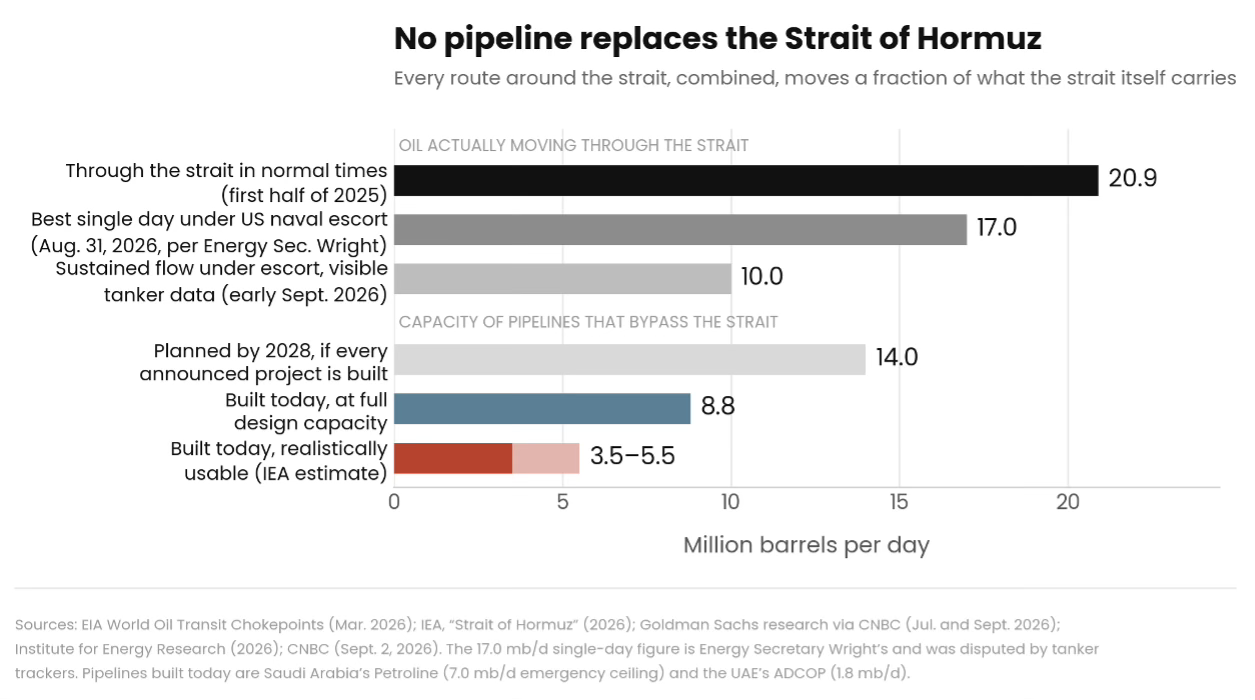
On the last day of August 2026, more than 17 million barrels of oil moved through the Strait of Hormuz under U.S. naval escort, a wartime record that Energy Secretary Chris Wright announced as ‘good news’, though tanker trackers disputed the count and put the sustained flow closer to 10 million barrels a day. In peacetime, that channel carried roughly 20 million barrels a day, about a quarter of the world’s seaborne oil trade, and it required no warships at all. The gap between those numbers reflects what the U.S./Israel-Iran war did to the global oil economy. Oil still moves through the Gulf. It now moves under guard.
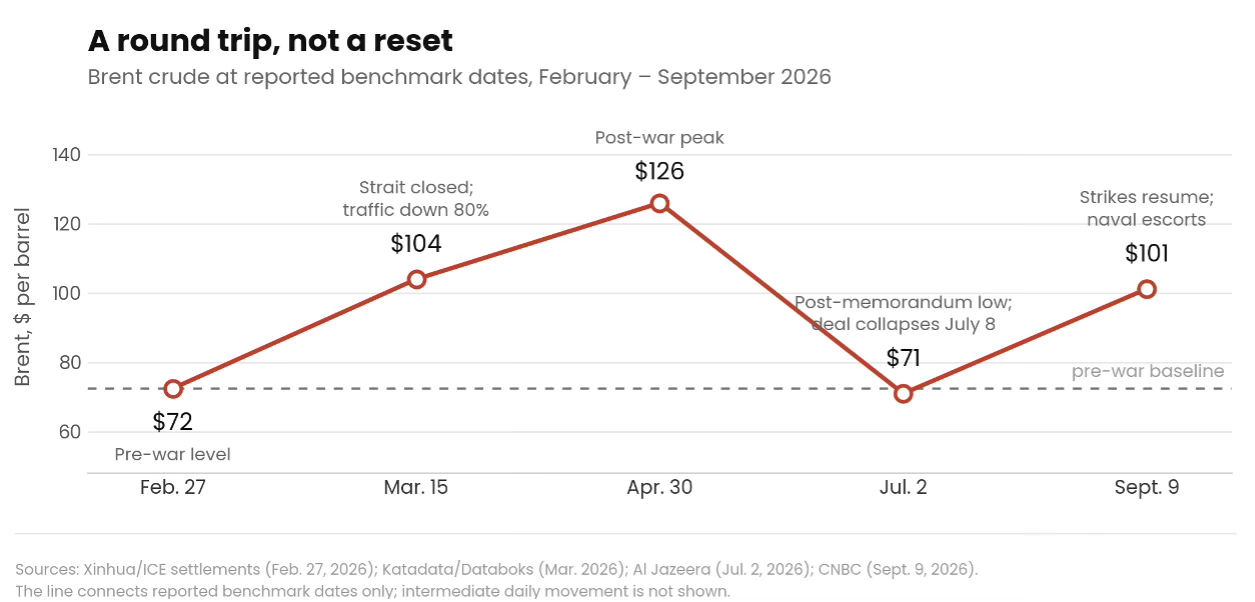
The shock arrived fast. U.S. and Israeli strikes killed Supreme Leader Ali Khamenei on February 28, and Iran moved to close the strait. Within 48 hours, insurers issued cancellation notices on war-risk cover and requoted it at 20 to 60 times the old rate, and tanker traffic fell by more than 80 percent. Brent, which settled at $72 the day before the strikes, passed $126 by the end of April. Iranian missile strikes on Ras Laffan knocked out about 17 percent of Qatar’s liquefied natural gas export capacity, some 12.8 million tons a year that QatarEnergy now expects will take three years to rebuild. The IMF cut its 2026 global growth forecast to 3.1 percent in April and raised its inflation projection to 4.4 percent, then decreased growth to 3 percent and increased inflation to 4.7 percent in July.
Those figures already read like history. An April ceasefire and a June memorandum brokered in Islamabad let stranded tankers out and pushed Brent back below $71 by early July. Then the deal collapsed within a month, and Brent climbed back above $100 in September as fighting resumed. Prices revert, but infrastructure does not.
What lasts longer than the initial impact is being built now. New pipelines. Rewritten supply contracts. A permanent risk premium on every shipment. And a security bargain between Washington and the Gulf that months of war quietly took apart. None of it shows up in the price of oil.
What chokepoint wars leave behind
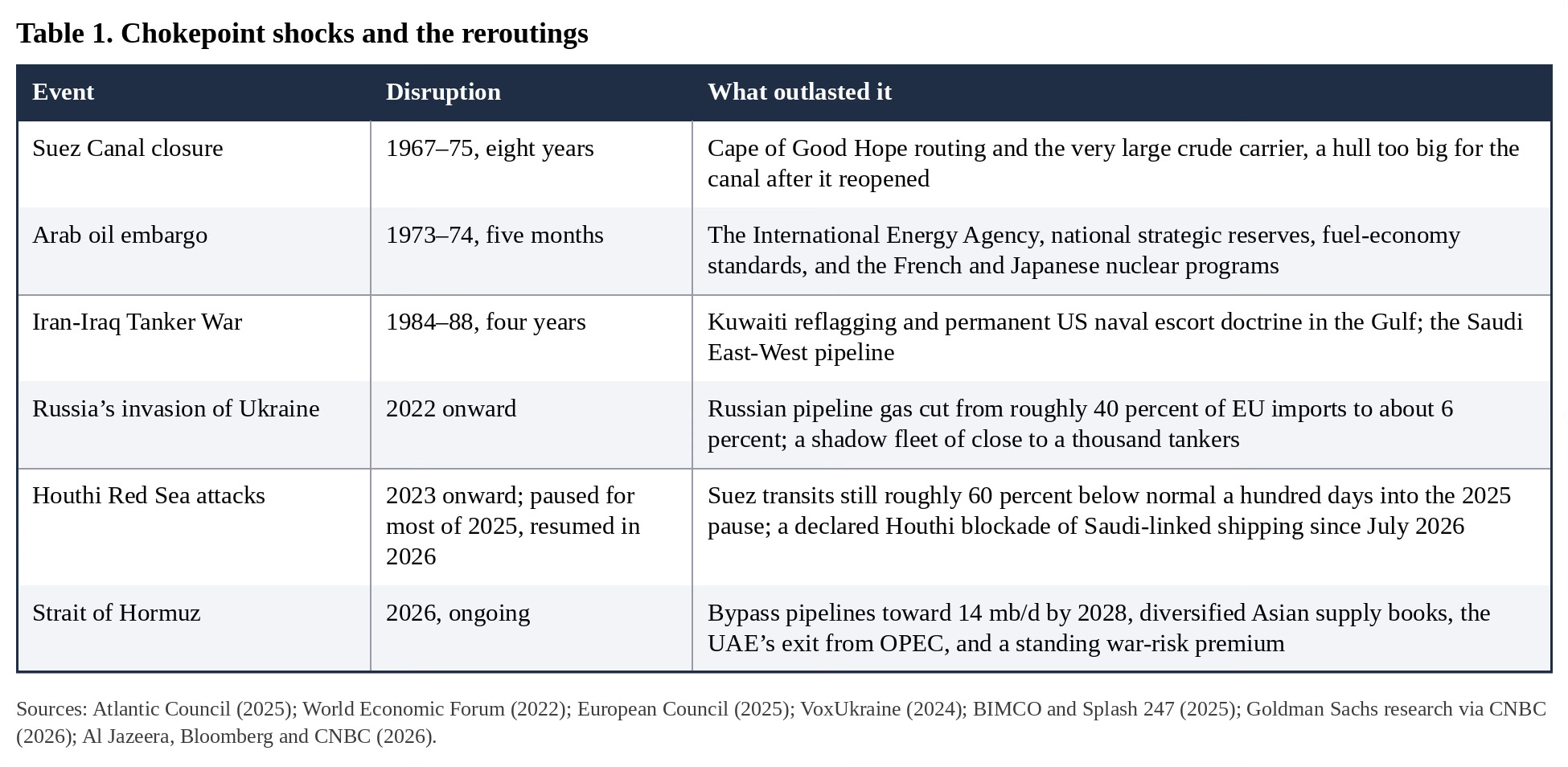
Egypt closed the Suez Canal in 1967, and kept it shut for eight years. Shippers rerouted around the Cape of Good Hope and to make the longer voyage worthwhile, scaled up to the very large crude carrier, a hull too big for the canal even after it reopened. The 1973 embargo lasted months and produced the International Energy Agency, national strategic reserves, fuel-economy standards, and the French and Japanese nuclear programs— institutions that still govern energy policy half a century later. Every one of those crises ended. Not one of the rerouted paths reversed.
Building around the strait
Producers responded with concrete. Saudi Arabia ran its East-West pipeline near its seven-million-barrel emergency ceiling and kept roughly 60 percent of its exports moving overland to the Red Sea. The UAE leaned on its Habshan-Fujairah line and accelerated a second route toward 3.6 million barrels a day by 2027. Goldman Sachs counts seven regional pipelines under construction or in planning, enough to lift bypass capacity past 14 million barrels a day by 2028. That still falls short of normal Hormuz capacity, and none of it will be dismantled when the shooting stops. Gas has no such workaround: QatarEnergy has rejected pipeline routes through neighboring states on commercial and technical grounds, so Qatar’s LNG will keep sailing through the strait or not at all.
Buyers moved suppliers as well. Indian refiners nearly tripled their purchase of Brazilian crude year on year by April, trading five-day Gulf runs for 25-day voyages, while U.S. crude exports set back-to-back monthly records of 5.2 million barrels a day in April and 5.6 million in May. IEA members released 400 million barrels of strategic stocks, the largest coordinated release on record and more than double the 2022 response. OPEC+ published monthly output increases through the spring, yet actual production fell from 42.77 million barrels a day in February to 33.13 million in May, showing how little spare capacity the group could physically deliver. The UAE, the group’s third-largest producer, drew its own conclusion and quit OPEC in late April, freeing itself to pump beyond any quota once the strait reopens. The transition felt the same pressure from the other direction: International Renewable Energy Agency (IRENA) reported that renewables reached 49 percent of global installed power capacity and 85.6 percent of annual additions by the end of 2025, and the war handed governments a security argument for electrification that very few climate targets, if at all, had managed to make as forcefully. But the early evidence cuts both ways. Electric vehicle sales accelerated in Europe and Asia over the war’s first seven months, while several Asian importers switched from gas to coal to keep the lights on.
Iranian retaliation damaged more than a dozen U.S. military sites across the Gulf, Jordan, and Iraq, and struck civilian infrastructure in Qatar, Kuwait, Saudi Arabia, and the UAE. Gulf governments learned that hosting American forces invited attack without guaranteeing protection. Riyadh widened its 2025 mutual defense agreement with Pakistan into a trilateral pact with Turkey, signed in Mecca on August 7, that treats an attack on any one of the three as an attack on all; Doha and Muscat kept their channels to Tehran open through the worst of the fighting, and Gulf capitals deepened their commercial and diplomatic relationship with Beijing even as China, the region’s largest customer, cut its crude imports by some 3.6 million barrels a day in the war’s first two months and depended on its stockpiles. Washington still supplies more than half of the region’s arms imports and stations tens of thousands of personnel across ten countries, and no Gulf state has asked those forces to leave. The Mecca Pact, for its part, met its first test within weeks: when Houthi missiles hit Saudi oil facilities in September, Riyadh asked neither Ankara nor Islamabad for help. What changed is the weight of the American guarantee, which Arab Gulf capitals now treat as one instrument among several rather than the foundation of their security.
Iran emerged from the war materially weaker. Kharg Island, which handles about 90 percent of its crude exports, loaded just 251,000 barrels a day in August under a U.S. naval blockade of Iranian ports, starving a state that has historically drawn a large portion of its budget from oil. Tehran did succeed in globalizing the conflict’s economic impact, forcing energy importers worldwide to absorb the costs of a closed strait. But a weakened Iran cannot rebuild the leverage it spent, and it also cannot credibly guarantee that it will not close the strait again.
The war left the Hormuz problem unsolved and turned it into a numbers game. Insurers, refiners, sovereign planners, and lenders now build an explicit chance of closure into what they charge and approve, and they will keep doing so as long as the geopolitical status quo holds. Once a risk gets repriced, capital reorganizes around it, and that reorganization takes years to complete and decades to unwind. The pipelines, the diversified supply channels, the enlarged reserves, and the accelerated build-out of domestic generation all follow from that single repricing.
The market recovery of the past two months tells you very little. The indicators that matter move on a slower clock. Do the Emirati and Saudi bypass lines hit their 2027 and 2028 targets on time? Do Asian buyers keep paying for longer voyages after the premium fades? Do Gulf states turn their new security partnerships into hardware and bases, or leave them as statements?
The strait may recover most of its volume while losing much of its meaning, in the way Suez did after 1975. The region’s energy geography could permanently shift westward and inland, toward the Red Sea, the Gulf of Oman, and overland routes through Turkey.
For Washington, the harder adjustment is political. The United States spent six months proving it can keep the world’s most important waterway open by force, and it demonstrated in the same six months that it cannot keep its partners safe while doing so. Those two facts sit together uncomfortably, and Gulf capitals have already begun budgeting for both. If American policy continues to measure its regional standing by tanker transits and troop numbers, it will keep reading the strait correctly and the region wrong. The war’s long-lasting outcome will not be a change in price, a route, or a ceasefire. It will be a set of assumptions that will not be restored.